Starting a coffee roasting business is exciting. Choosing the right roaster is not.
It’s one of the most expensive and strategically important decisions you’ll make — and choosing incorrectly can either limit your growth or create unnecessary financial pressure.
This guide will help you choose based on logic, not emotion.
If you haven’t read the fundamentals yet, start with:
How to start a Coffee Roasting Business?.
Step 1: Start With Sales — Not With Machine Size
Most beginners ask:
“Should I buy a 3 kg or 6 kg machine?”
That’s the wrong first question.
The right question is:
How much coffee do I realistically plan to sell per month?
Because production capacity must match your sales strategy.
Production math explained in:
[How Much Coffee Can a Commercial Roaster Produce Per Day?](https:// how-much-coffee-can-a-commercial-roaster-produce-per-day/).
Quick Monthly Output Reference
Realistic Monthly Production by Machine Size
| Machine Size | Realistic Monthly Output (Roasted) | Best For |
|---|---|---|
| 1–3 kg | 100–400 kg | Micro retail |
| 6 kg | 600–900 kg | Retail + light wholesale |
| 12–15 kg | 1,200–2,000 kg | Structured wholesale |
| 20 kg+ | 2,000+ kg | Scaling / regional supply |
These are realistic numbers accounting for weight loss and workflow — not theoretical maximums.
👉 If you’d like to compare actual commercial roasting machines by capacity, you can explore our full range here:
Commercial Coffee Roasting Machines.
Step 2: Avoid the “Too Small” Trap
Buying too small creates hidden costs:
- Excessive roasting days
- Operator fatigue
- Higher gas consumption per kg
- Limited growth capacity
Many startups outgrow a 3 kg machine within 12–18 months.
Upgrading too early doubles investment.
See sizing fundamentals in:
How to Choose the Right Coffee Roaster Size.
Step 3: Avoid the “Too Large” Trap
Buying too large creates different risks:
- High upfront investment
- Underutilized capacity
- Slower ROI
- Cash flow pressure
If you don’t yet have confirmed wholesale accounts, oversizing increases financial stress.
Investment planning breakdown:
Coffee Roasting Business Startup Costs Explained.
Step 4: Evaluate Engineering — Not Just Batch Size
Two 6 kg machines can behave completely differently.
Key Technical Factors
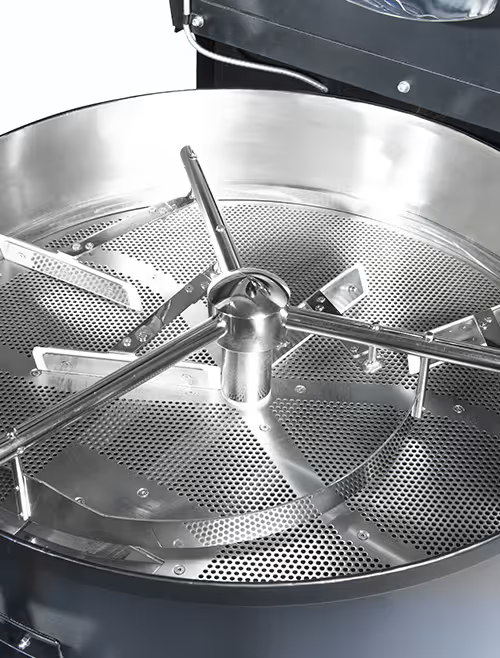
1. Drum Design
Important elements include:
- Drum thickness
- Diameter-to-depth ratio
- Material quality
2. Heat Transfer System
Roasting relies on:
- Conduction
- Convection
- Radiation
Balanced heat transfer creates repeatable results.
3. Thermal Stability
Weak thermal mass causes:
- Temperature crashes
- Longer recovery times
- Inconsistent profiles
Step 5: Gas vs Electric for a Startup
For commercial production above 3 kg, gas remains the dominant professional choice.
Gas Roasters Offer
- Faster heat response
- Lower long-term operating cost
- Better scalability
Electric Roasters May Be Suitable For
- Small spaces
- Low production environments
- Regions with gas restrictions
Full comparison:
[Gas vs Electric Coffee Roasters: Pros and Cons](https:// gas-vs-electric-coffee-roasters/).
Step 6: Manual vs Automatic — What Does a Startup Really Need?
Automation increases repeatability.
But automation does not replace good engineering.
Startups Often Benefit From
- Semi-automatic systems
- PID temperature monitoring
- Adjustable airflow control
Full PLC Automation Is Useful When
- Multiple operators work shifts
- Large-scale production is required
Comparison guide:
[Manual vs Automatic Coffee Roasting Machines](https:// manual-vs-automatic-coffee-roasting-machines/).
Step 7: Think 3 Years Ahead
Ask yourself:
If my sales double in 18 months, will this machine support that growth?
If the answer is no, consider sizing slightly above your immediate need — but not excessively.
Sustainable scaling is smarter than emergency upgrades.
Step 8: Match Machine to Business Model
Different startup goals require different machines.
Retail-Focused Brand
- 3–6 kg
- Emphasis on profile development
- Lower daily volume
Retail + Wholesale Hybrid
- 6–12 kg
- Balanced production
- Moderate scaling capacity
Wholesale-Oriented Startup
- 12–15 kg minimum
- Strong thermal stability
- Efficient between-batch recovery
Avoid buying based only on price.
Buy based on business structure.
Common Startup Buying Mistakes
New entrepreneurs often:
- ❌ Buy based on discount
- ❌ Ignore installation requirements
- ❌ Underestimate ventilation cost
- ❌ Skip engineering comparison
- ❌ Overestimate initial sales
Final Decision Framework
Before choosing your startup roaster, define:
- Target monthly sales (12-month realistic projection)
- Business model (retail / wholesale / hybrid)
- Available installation space
- Gas availability
- Budget range including infrastructure
When those five are clear, the correct machine size becomes obvious.
Final Thoughts
Choosing the right coffee roaster for a startup is not about buying the biggest machine you can afford.
It’s about balancing:
- Production capacity
- Financial risk
- Growth potential
- Engineering quality
Make the decision based on structure — not excitement.