What Is a Commercial Coffee Roasting Machine?
A commercial coffee roasting machine is engineered for one purpose: consistent, repeatable coffee production at scale.
Unlike small home or sample roasters, commercial systems are built for:
- Thermal stability
- Precise airflow control
- Durable industrial construction
- Continuous batch operation
At this level, a coffee roasting machine is not just equipment — it defines your product quality, efficiency, and brand reputation.
The roast profile your customers experience every day depends on machine stability and heat precision.
Choosing the right system is a strategic business decision — not just a technical one.
Why the Right Machine Impacts Your Entire Business
Many buyers initially compare price and capacity. However, long-term success depends on engineering quality.
The right commercial coffee roasting machine influences:
- Roast consistency
- Heat response precision
- Airflow balance
- Energy efficiency
- Maintenance frequency
- Software compatibility
- Production scalability
An unstable system causes uneven development, inconsistent roast curves, wasted fuel, and production delays.
A well-engineered machine works quietly in the background — allowing you to focus on growth and quality.
Capacity: Plan for Growth, Not Just Today
Commercial machines range from compact production units to industrial-scale systems.
When selecting capacity, evaluate:
- Weekly roasting volume
- Retail vs wholesale focus
- Ventilation infrastructure
- Growth projections
Choosing too small limits expansion. Choosing too large increases operating costs unnecessarily.
For a detailed breakdown of production calculations, read our guide on How to Choose the Right Coffee Roaster Capacity.
A properly sized commercial coffee roasting machine supports daily consistency while giving your business room to grow.
Understanding Heat Transfer and Roast Control
Most professional coffee roasting machines use drum roasting technology.
Heat transfer occurs through:
- Conduction (drum contact)
- Convection (controlled airflow)
- Radiant heat
The balance between these elements determines:
- Flavor clarity
- Body
- Development precision
- Roast repeatability
What separates professional systems from average ones is airflow engineering. Stable airflow enables smoother rate-of-rise control and more predictable development.
If you want a structured comparison framework, see:
How to Compare Commercial Coffee Roasting Machines
Gas vs Electric Coffee Roasters
Heat source is another major decision when investing in a commercial coffee roasting machine.
Gas Systems
- Strong thermal power
- Fast heat adjustment response
- Efficient for mid to large-scale production
- Preferred in specialty roasting
Electric Systems
- Simpler installation
- Suitable for controlled indoor environments
- Common in smaller production setups
For growing roasting businesses, gas systems typically offer stronger responsiveness and long-term efficiency.
Full comparison:
Gas vs Electric Coffee Roasters: Pros and Cons
Software Integration: A Competitive Advantage
Modern roasting is data-driven.
A commercial coffee roasting machine that integrates with professional platforms gives you measurable control.
Widely used industry software includes:
- Artisan
- Cropster
These tools allow you to:
- Track roast curves
- Monitor rate-of-rise
- Replicate successful profiles
- Compare batches
- Standardize team training
- Maintain quality control
Machines with smooth software integration offer long-term operational stability.
Build Quality: What Actually Matters
When comparing a commercial coffee roasting machine, evaluate engineering — not just appearance.
Focus on:
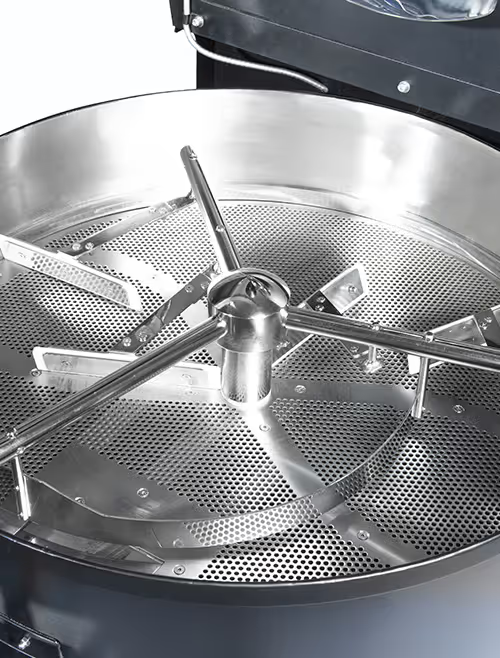
- Drum thickness and steel quality
- Burner design efficiency
- Airflow precision system
- Cooling tray performance
- Electrical component durability
- Maintenance accessibility
Industrial-grade construction reduces downtime and protects your investment.
You can explore professional systems here: 👉 Commercial Coffee Roasters
Investment Considerations
Investment levels vary based on capacity and engineering complexity.
Instead of focusing only on purchase price, evaluate:
- Cost per kilogram roasted
- Energy efficiency
- Output per hour
- Maintenance intervals
- Long-term durability
A well-built coffee roasting machine reduces waste, stabilizes production, and protects brand consistency — directly impacting profitability.
The Marketing Advantage of Owning a Roastery
Owning a commercial coffee roasting machine transforms your market position.
When you roast in-house, you control the entire value chain — from green bean to final profile.
This allows you to:
- Market “freshly roasted” coffee
- Display roast dates
- Share origin stories
- Offer seasonal releases
- Demonstrate quality control
- Position your brand as a producer
Customers increasingly value transparency and craftsmanship.
The statement “We roast our own coffee” builds trust.
From a branding perspective, owning a roasting operation creates differentiation and strengthens long-term positioning.
Who Should Invest in a Commercial Coffee Roasting Machine?
You likely need one if you are:
- Launching a specialty coffee brand
- Expanding from café to roastery
- Entering wholesale supply
- Building a private label line
- Scaling regional distribution
Professional roasting equipment gives you control over:
- Quality
- Cost structure
- Brand direction
Final Thoughts
Choosing a commercial coffee roasting machine is both technical and strategic.
The right system supports:
- Stable roast development
- Efficient production
- Data-driven quality control
- Scalable growth
- Stronger brand positioning
As competition in specialty coffee grows, businesses investing in reliable, well-engineered roasting systems gain both operational and marketing advantages.
In roasting, consistency builds trust. And trust builds brands.