When comparing commercial coffee roasting machines, most buyers focus on one number:
Batch capacity.
- 15 kg
- 20 kg
- 30 kg
But experienced roasters know something important:
Capacity alone does not define performance.
Drum diameter plays a much bigger role than most people realize.
And to truly understand why, you first need to understand how professional coffee roasters are engineered.
How Professional Coffee Roasters Are Engineered?
Because drum geometry is not just mechanical design—it directly affects heat transfer, airflow, and roast consistency.
Why Batch Capacity Can Be Misleading
Batch capacity simply tells you how many kilograms of green coffee the drum can hold.
It does not tell you:
- How evenly the beans will develop
- How stable the heat distribution will be
- How efficiently airflow will penetrate the batch
- How repeatable your roast profiles will be
Two machines may both be labeled “15 kg.”
Yet their roast results can be completely different.
Why?
Because of drum diameter.
What Drum Diameter Actually Controls
Drum diameter affects three critical engineering factors:
- Heat transfer balance
- Bean movement dynamics
- Airflow penetration
Let’s look at each one.
1. Drum Diameter and Heat Transfer
In commercial roasting, heat reaches the beans through:
- Conduction (contact with the drum surface)
- Convection (hot air movement)
- Radiation (infrared energy)
Why Larger Drums Behave Differently
A larger drum diameter provides:
- Larger contact surface
- More even heat distribution
- Greater thermal mass
- Smoother energy transfer
A smaller drum diameter often results in:
- Faster surface heating
- Higher scorching risk
- Less forgiving roast behavior
In production roasting, stability matters more than aggressive heat.
2. Bean Movement and Drop Distance
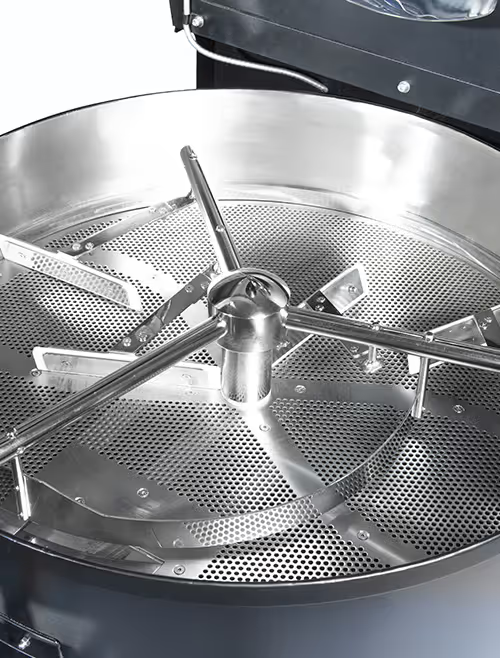
Drum diameter determines how beans tumble inside the roasting chamber.
How Bean Movement Affects Roast Quality
In larger diameter drums:
- Beans fall from a higher position
- Agitation is more dynamic
- Mixing becomes more uniform
This improves:
- Color uniformity
- Internal development
- Flavor consistency
In smaller drums, beans may slide instead of tumble properly, reducing development uniformity.
This directly impacts roast repeatability.
3. Airflow Penetration and Bean Depth
Drum diameter also affects how air moves through the bean mass.
If the diameter is too small relative to batch size:
- Bean layers become too thick
- Air cannot reach the center evenly
- Development becomes uneven
air is a primary heat carrier—not just a ventilation system.
Why Airflow Depends on Drum Geometry
If drum geometry restricts airflow:
- Convection efficiency drops
- Heat transfer becomes inconsistent
- Profile control becomes unstable
This is one reason why drum engineering matters more than capacity labels.
The Diameter-to-Capacity Balance
Professional manufacturers do not design drums by simply extending drum length to increase capacity.
There is a precise relationship between:
- Drum diameter
- Drum length
- Batch size
- Airflow power
- Burner capacity
Why Geometry Must Be Balanced
If drum length increases without the proper diameter ratio:
- Bean depth increases excessively
- Airflow resistance rises
- Center beans underdevelop
- Outer beans overdevelop
This is how some machines advertise higher capacity while sacrificing roast quality.
Serious engineering avoids this shortcut.
Thermal Stability and Production Reality
Larger diameter drums typically have greater thermal mass.
This means:
- More stable heat behavior
- Less temperature fluctuation
- Faster recovery between batches
For a broader understanding of production roasting systems, read:
Commercial Coffee Roasting Machine Selection.
Why Thermal Stability Matters
In commercial environments, consistency across multiple consecutive batches is critical.
Drum diameter strongly influences that consistency.
What Buyers Should Ask
Before choosing a commercial coffee roaster, ask:
- What is the drum diameter?
- What is the drum length?
- What is the drum wall thickness?
- Has the geometry been optimized for airflow?
- Is capacity increased by length alone?
If the seller only talks about kilograms and not geometry, the engineering depth may be limited.
For examples of professionally engineered roasting systems:
Final Insight
Batch capacity is a number.
Drum diameter is performance.
A well-balanced 15 kg drum can outperform a poorly designed 20 kg drum.
In professional roasting:
- Geometry defines heat transfer
- Heat transfer defines consistency
- Consistency defines brand quality
And serious commercial coffee roasters are built around that understanding.