Airflow Control in Commercial Coffee Roasters: Why It Matters More Than You Think
When people talk about roasting coffee, they usually focus on temperature.
But temperature alone doesn’t define a roast.
Airflow does.
In fact, airflow is one of the core engineering principles behind How Professional Coffee Roasters Are Engineered?.
In commercial coffee roasters, airflow determines:
- How heat moves through the bean mass
- How moisture escapes
- How smoke is removed
- How clean the cup tastes
- How stable the roast curve remains
Without proper airflow control, even a powerful burner cannot produce consistent results.
For roasters looking for precise airflow management and industrial-grade engineering, explore our Commercial Coffee Roasters designed for professional and specialty coffee production.
What Airflow Actually Does During Roasting
Airflow is much more than ventilation. It directly influences every stage of the roasting process by controlling:
- Convection heat transfer
- Rate of Rise (RoR) behavior
- Smoke evacuation
- Chaff removal
- Pressure balance inside the drum
As explained in our guide on Heat Transfer In Coffee Roasting., convection is heat carried by moving air. This makes airflow one of the primary mechanisms of heat transfer rather than simply an exhaust function.
Airflow and Convection: The Development Engine
Hot air flows through the bean mass, transferring energy directly into the beans.
Higher Airflow
- Faster moisture removal
- Cleaner flavor profile
- Brighter acidity
- Better clarity in light roasts
Lower Airflow
- Slower drying phase
- Heavier body
- Greater risk of smoky flavors
- Potentially uneven development
Professional commercial coffee roasters allow airflow to be adjusted independently from burner power. Separating these two controls gives the roaster far greater flexibility and precision throughout the roast.
Airflow and Drum Geometry
Airflow performance cannot be separated from drum design.
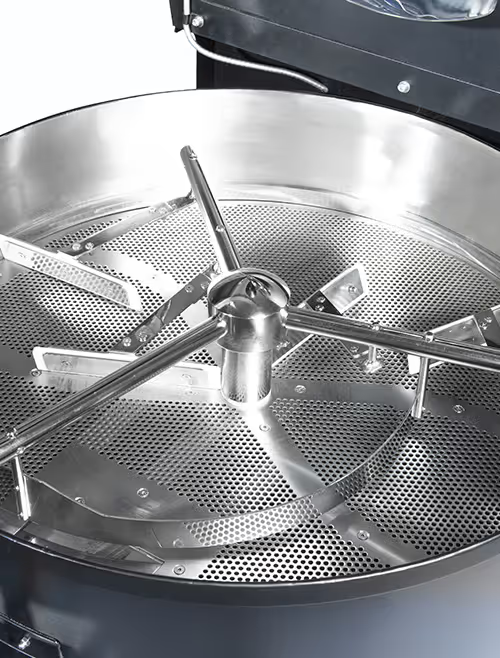
Drum diameter, drum length, and the internal geometry of the roasting drum all influence how air penetrates the bean mass.
If you haven’t already, read our article on Drum Diameter vs. Batch Capacity: what really matters? to understand how drum geometry affects roasting performance.
Poorly engineered drum proportions can lead to:
- Air failing to reach the center of the batch
- Uneven bean movement
- Inconsistent development
Effective airflow design and intelligent drum engineering must work together to produce repeatable roasting results.
Smoke Management and Cup Cleanliness
During roasting:
- Sugars caramelize.
- Organic compounds break down.
- Smoke and gases are released.
If smoke is not efficiently removed:
- It circulates back into the drum.
- It coats the beans.
- It reduces flavor clarity.
Proper airflow provides:
- Efficient smoke evacuation
- Cleaner cup profiles
- Brighter acidity
- Reduced bitterness
This is especially important in specialty coffee roasting, where flavor clarity is one of the primary quality indicators.
Static vs. Adjustable Airflow Systems
Not every commercial coffee roaster offers the same level of airflow control.
Many entry-level machines rely on:
- Fixed airflow systems
- Weak exhaust fans
- Non-adjustable dampers
These limitations reduce roasting flexibility and make profile development more difficult.
Professional roasting systems typically include:
- Industrial-grade exhaust fans
- Real-time airflow adjustment
- Stable pressure regulation
- Balanced exhaust engineering
Without dynamic airflow control, achieving repeatable roast profiles becomes significantly more challenging.
Airflow and Thermal Stability
Airflow directly influences temperature stability throughout the roast.
Excessive airflow can:
- Cool the drum surface
- Reduce heat retention
- Slow bean development
Insufficient airflow can:
- Trap excessive heat
- Create unstable internal pressure
- Cause sudden increases in the Rate of Rise
As discussed in our guide to Heat Transfer In Coffee Roasting, successful roasting depends on balancing conduction, convection, and radiation rather than maximizing any single heat source.
Professional roasting is built on balance—not simply power.
Airflow Between Consecutive Batches
In production roasting, airflow also determines how quickly a machine recovers between batches.
After a batch is discharged:
- Residual smoke remains inside the system.
- Internal pressure must normalize.
- Drum conditions need to stabilize.
Strong airflow systems help:
- Clear smoke rapidly
- Stabilize internal conditions
- Prepare the machine for the next batch more quickly
Weak airflow systems often result in:
- Heat inconsistency
- Flavor variation between batches
- Longer production cycles
Over time, these issues reduce productivity and increase operating costs.
If you’re comparing machines for continuous production, begin with our Complete Guide to Commercial Coffee Roasting Machines to understand the engineering differences that matter most.
What Buyers Should Ask
Before purchasing a commercial coffee roaster, consider asking:
- Is airflow independently adjustable from burner power?
- What is the exhaust fan capacity?
- How is pressure stabilized inside the drum?
- How does the airflow system perform between consecutive batches?
- Is the machine engineered for continuous production?
If airflow engineering is weak, long-term roast consistency will inevitably suffer—regardless of the machine’s batch capacity.
Final Thoughts
Airflow control in commercial coffee roasters is far more than a secondary feature.
It is one of the core engineering systems that determines roast quality.
Air carries heat.
Air shapes bean development.
Air preserves flavor clarity.
Air ensures consistency.
The best professional coffee roasting machines are defined not by how much heat they generate, but by how precisely they manage that heat.
At the center of that precision is a well-engineered airflow system.