Heat Transfer in Coffee Roasting: Why It Defines Roast Quality
Roasting coffee is not just about applying heat. It’s about how heat moves.
In professional systems, heat transfer in coffee roasting determines:
- Development uniformity
- Flavor clarity
- Body and sweetness
- Roast repeatability
To fully understand this, you first need to understand how professional coffee roasters are engineered.
👉 How Professional Coffee Roasters Are Engineered?
Heat transfer is not accidental—it is designed.
Every roast relies on three fundamental heat transfer mechanisms:
- Conduction
- Convection
- Radiation
A high-quality commercial coffee roaster carefully balances all three.
Conduction: Direct Contact Heat
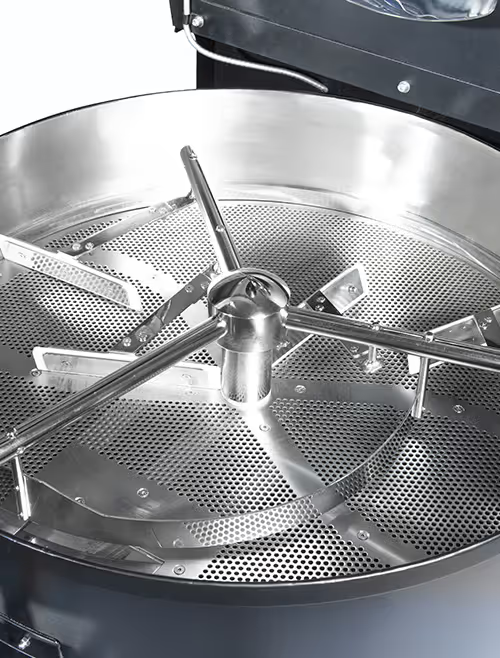
Conduction occurs when coffee beans make direct contact with the hot drum surface. It is the most immediate and aggressive form of heat transfer during roasting.
How Conduction Works
- The drum surface heats up.
- Beans absorb energy through direct contact.
- Heat moves inward from the bean surface toward the center.
Drum geometry has a major influence on conduction performance.
For a detailed explanation, read:
👉 Drum Diameter vs Batch Capacity: What Really Matters
A properly proportioned drum provides:
- More even bean contact
- Better energy distribution
- Lower risk of scorching
When conduction becomes excessive, problems begin to appear:
- Tipping defects
- Surface scorching
- Underdeveloped bean interiors
Professional coffee roasters carefully balance drum temperature, drum speed, and burner output to prevent these issues.
Convection: Heat Carried by Air
Convection is heat transferred through moving hot air.
In modern commercial coffee roasters, convection is the primary source of internal bean development.
How Convection Works
- Heated air flows through the bean mass.
- Energy penetrates deep into each bean.
- Moisture is removed efficiently.
Airflow control is the key to stable convection.
Without consistent airflow, roast development becomes inconsistent.
Learn more here:
👉 Airflow Control in Commercial Coffee Roasters
Why Convection Matters
Well-controlled convection typically produces:
- Cleaner cup profiles
- Brighter acidity
- Better flavor clarity
However, excessive airflow can:
- Cool the drum too aggressively
- Slow bean development
- Reduce body and sweetness
The goal is not maximum airflow—it is precise airflow control.
Radiation: Infrared Energy Contribution
Radiation transfers heat through infrared energy without direct contact.
It originates from:
- The burner flame
- Heated drum walls
- Internal metal components
Unlike conduction and convection, radiation acts as a constant background heat source.
It helps stabilize the roasting environment.
Poorly engineered machines often produce radiation that is:
- Uneven
- Too aggressive
- Difficult to control
Professional gas-powered coffee roasters regulate radiation through burner design and chamber insulation, providing better consistency from batch to batch.
Balancing Conduction, Convection, and Radiation
The best commercial coffee roasters do not maximize one heat transfer method.
Instead, they balance all three.
For example:
- Espresso roasting often benefits from slightly stronger conduction.
- Filter coffee typically favors greater convection.
- Light specialty roasts require a carefully balanced combination of all three.
The ability to fine-tune this balance depends entirely on machine engineering.
Without proper drum geometry or airflow control, maintaining consistent heat transfer becomes extremely difficult.
Heat Transfer and Production Stability
In commercial production roasting, consistency between batches is essential.
Heat transfer design directly affects:
- Recovery time
- Rate of Rise (RoR) stability
- First crack consistency
- Roast profile repeatability
Poor heat transfer engineering often leads to:
- Fluctuating roast curves
- Unpredictable development
- Constant manual adjustments by the operator
If you’re comparing machines for professional production, start with:
👉 Commercial Coffee Roasting Machine Selection.
Although heat transfer design cannot be seen from outside the machine, it defines nearly everything happening inside the roasting chamber.
Signs of Poor Heat Transfer Engineering
Weak heat transfer design often reveals itself through:
- Uneven bean color
- Inconsistent first crack timing
- Stalling during development
- Sudden temperature spikes
Many operators assume these problems result from roasting technique.
In reality, they are frequently caused by:
- Poor drum design
- Weak airflow systems
- Unstable burner configuration
Good engineering expands the operator’s control.
Poor engineering limits it.
Questions Buyers Should Ask
If you’re comparing different machines, it’s also worth reviewing the technical specifications of modern commercial coffee roasters to see how manufacturers approach drum design, airflow control, burner technology, and automation features.
For examples of professionally engineered roasting systems:
Before purchasing a commercial coffee roaster, ask the manufacturer:
- How is heat distributed inside the drum?
- What is the balance between conduction and convection?
- Is airflow independently adjustable?
- How quickly does the machine recover between batches?
- What type of burner system is used?
If these questions cannot be answered clearly, the machine’s heat transfer system may not provide the consistency required for professional roasting.
Final Thoughts
Heat transfer in coffee roasting is the foundation of flavor development.
Each mechanism plays a distinct role:
- Conduction builds structure.
- Convection develops clarity.
- Radiation stabilizes the roasting environment.
Professional commercial coffee roasters are engineered to balance these forces—not simply to generate heat.
When heat moves correctly, roasting becomes predictable.
And when roasting becomes predictable, consistency follows.