In commercial roasting, consistency is everything.
Customers expect the same flavour profile every time they open a bag.
But consistency doesn’t start with the roast profile.
It starts with thermal stability.
Thermal stability in coffee roasters refers to how well a machine maintains controlled, predictable heat throughout the roasting process — and between consecutive batches.
To understand why this matters, you first need to understand
👉 How Professional Coffee Roasters Are Engineered?
Because stability is not accidental.
It is designed.
What Is Thermal Stability in Coffee Roasting?
Thermal stability means:
- Drum temperature remains predictable
- Heat response is smooth
- Energy application is controlled
- Recovery between batches is fast
An unstable machine behaves like this:
-
❌ Sudden temperature spikes
-
❌ Slow response to adjustments
-
❌ Inconsistent rate of rise
-
❌ Different results with the same profile
A stable machine behaves like this:
-
✔ Smooth roast curves
-
✔ Predictable first crack timing
-
✔ Repeatable development
-
✔ Consistent batch-to-batch results
In commercial production, this difference is critical.
What Affects Thermal Stability?
Thermal stability in professional coffee roasters depends on five key engineering factors:
1️⃣ Drum mass and geometry
2️⃣ Burner system quality
3️⃣ Airflow control
4️⃣ Insulation
5️⃣ Structural design
Let’s break these down.
1️⃣ Drum Mass and Geometry
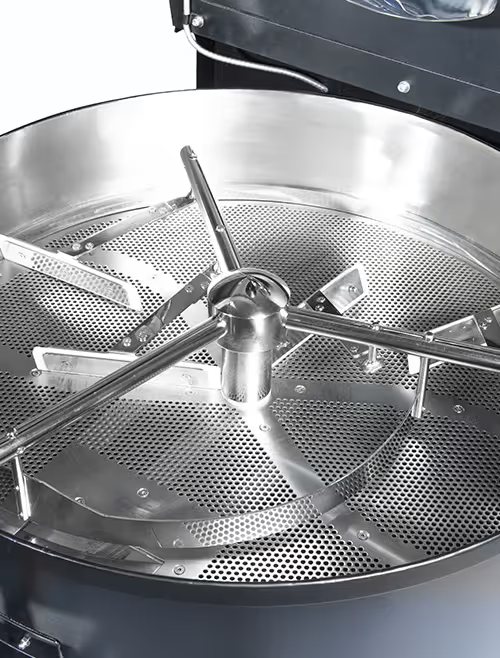
The drum acts as a thermal buffer.
A heavier, properly engineered drum:
- Stores heat efficiently
- Reduces temperature fluctuation
- Improves energy smoothness
Drum diameter plays a major role here.
If you haven’t read it yet, see Drum diameter vs Batch capacity to understand how geometry influences heat behaviour.
Thin or poorly proportioned drums tend to:
- Overreact to burner changes
- Lose heat quickly
- Create unstable roast curves
Thermal mass equals stability.
2️⃣ Burner System Quality
In gas-powered machines, the burner is the primary energy source.
If burner modulation is unstable:
- Heat fluctuates
- Radiation becomes uneven
- Roast control weakens
As explained in burner systems in gas coffee roasters, flame control and response time directly influence stability.
A professional burner system should:
-
✔ Respond quickly to adjustments
-
✔ Maintain steady flame intensity
-
✔ Support smooth rate-of-rise control
Weak burner systems create reactive roasting instead of controlled roasting.
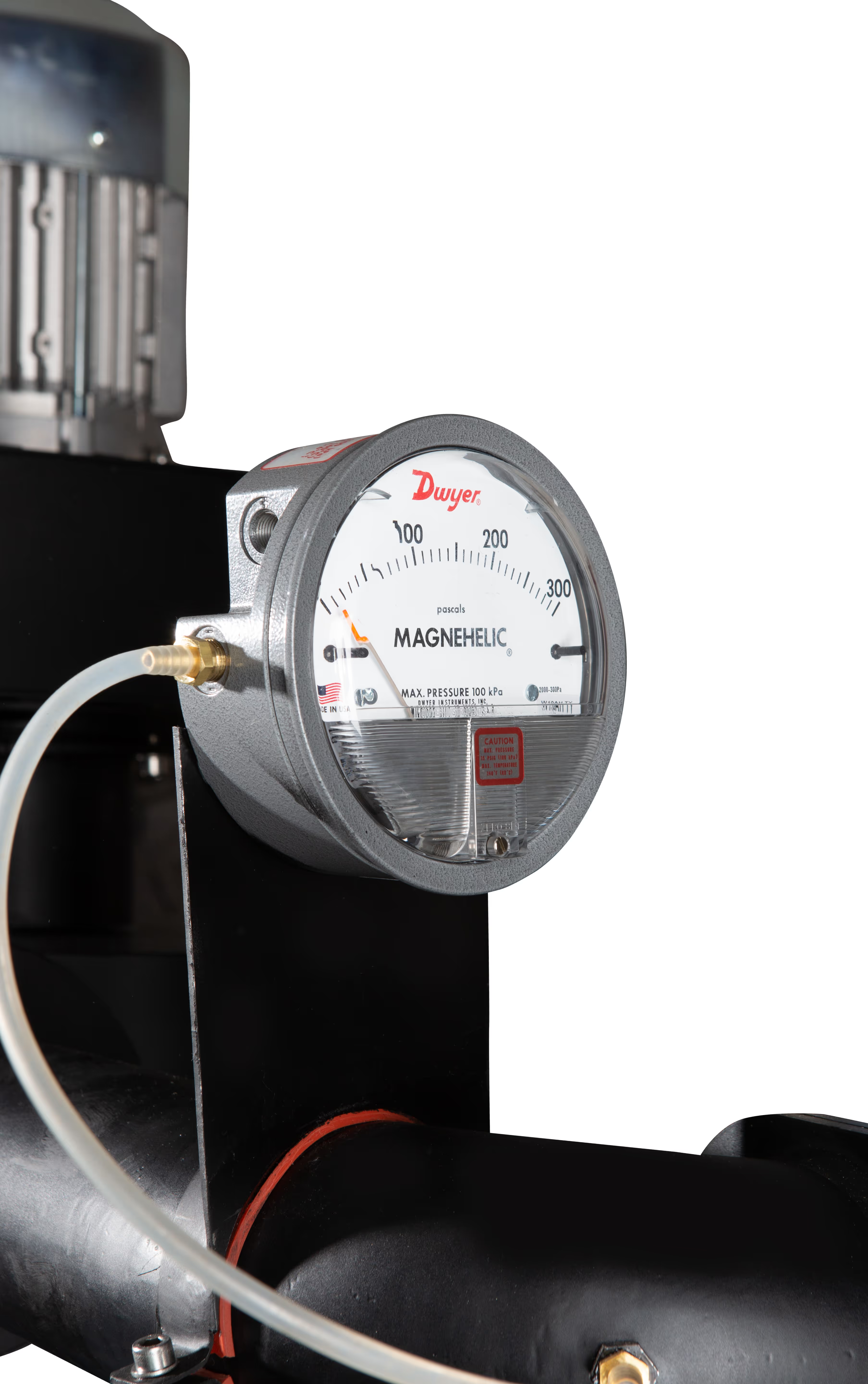
3️⃣ Airflow Control and Pressure Balance
Airflow impacts both convection and temperature stability.
Too much airflow:
- Cools the drum
- Causes energy drops
- Creates unstable development
Too little airflow:
- Traps excess heat
- Increases pressure
- Accelerates roast unpredictably
As detailed in Airflow control in commercial coffee roasters, precision airflow management is essential for maintaining balanced heat transfer.
Airflow and burner must work together.
4️⃣ Heat Transfer Balance
Thermal stability is also about balancing:
- Conduction
- Convection
- Radiation
If one heat transfer mechanism dominates, stability suffers.
For a full breakdown, see heat transfer in coffee roasting.
Professional machines are engineered to harmonize these forces.
This harmony creates smooth and predictable roast behavior.
5️⃣ Insulation and Structural Design
Chamber insulation affects how much heat escapes during roasting.
Poor insulation causes:
- Heat loss
- Burner overcompensation
- Energy instability
High-quality commercial machines use proper insulation and chamber design to:
✔ Retain heat efficiently
✔ Reduce energy waste
✔ Improve batch consistency
This is particularly important in high-capacity production environments.
If you are comparing production-ready systems, start with the complete guide to commercial coffee roasting machines to understand structural quality differences.
For production applications, you can also explore KRAFFE commercial and industrial coffee roasters designed for professional roasting environments.
Thermal Stability Between Consecutive Batches
In commercial roasting, machines often run continuously.
A thermally stable machine will:
- Recover quickly after bean discharge
- Maintain drum temperature
- Stabilize airflow rapidly
- Produce consistent first crack timing
An unstable machine may show:
-
❌ Drift in roast curves
-
❌ Flavor inconsistency
-
❌ Longer stabilization time
-
❌ Increased operator compensation
Over time, instability reduces both quality and efficiency.
Why Roast Consistency Defines Brand Reputation
Customers rarely forgive inconsistency.
If one batch tastes perfect and the next tastes different:
- Trust declines
- Brand value weakens
- Wholesale relationships suffer
Roast consistency is not just an operational goal.
It is a business necessity.
And roast consistency begins with thermal stability.
What Buyers Should Ask
Before investing in a commercial coffee roaster, ask:
- How stable is drum temperature during long production sessions?
- How fast does the machine recover between batches?
- Is airflow independently adjustable?
- How precise is burner modulation?
- What is the drum wall thickness?
If these answers are vague, stability may be limited.
Final Thoughts
Thermal stability in coffee roasters is not a luxury feature.
It is the foundation of consistency.
A professional commercial coffee roaster is defined by:
- Balanced heat transfer
- Stable burner performance
- Controlled airflow
- Proper drum mass
- Efficient insulation
When the machine is stable, roasting becomes predictable.
And when roasting is predictable, consistency becomes natural.